
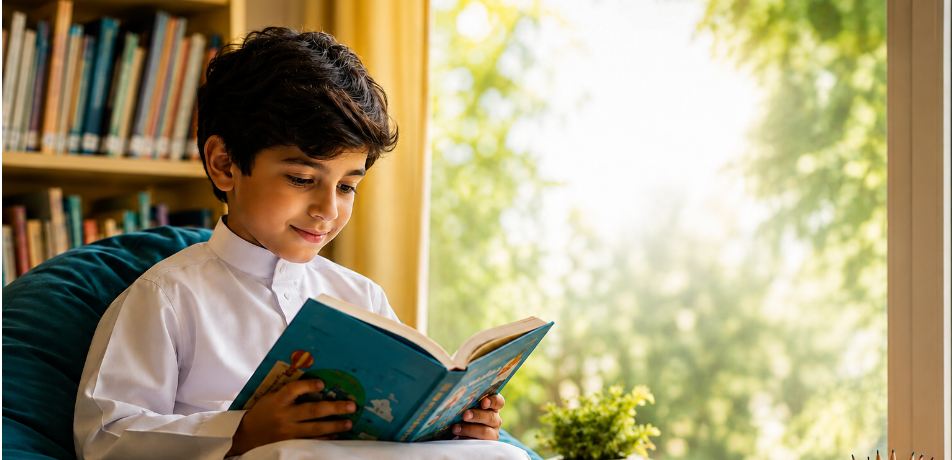
Raising a child who loves to read is not merely an educational endeavor; it is a journey that begins in the earliest stages of life. Studies suggest that even in the womb, a baby responds to the tone of the mother’s voice and the rhythm of her words as she reads aloud, laying the foundation for an early emotional connection with language.
This connection grows and develops during early childhood through picture books and listening to simple stories. It then continues at school—the child’s second home—where the role of teachers and families extends far beyond developing basic reading skills. Together, they help shape the child’s awareness, build their character and broaden their understanding of the world.
When you see a child reading, you can often notice their alertness, strong language skills and distinctive ability to express themselves. Reading is not simply a form of entertainment; it is a powerful tool for developing a child’s intellectual, linguistic and cognitive abilities.
Through regular reading, children develop their speaking and writing skills simultaneously. Continuous exposure to new words, sentence structures and different writing styles gives them a rich vocabulary, enabling them to form sentences more effectively and express their ideas with confidence and clarity. It also strengthens their ability to tell stories and organize their thoughts in a coherent and creative way.
Over time, children who read develop a broader cultural and intellectual foundation, as books introduce them to a wide range of ideas, experiences and worlds. This makes them better able to understand and analyze information, draw connections between different concepts and think critically.
The benefits of reading are not limited to language development. Reading also helps improve concentration and attention. Children who become accustomed to reading or listening to stories from an early age develop a stronger ability to focus, particularly when following events and characters or answering questions about a story. Using different voices for different characters and varying the tone while reading can also encourage children to pay closer attention to detail, develop active listening skills and stimulate their imagination.
Children who read also tend to have richer and more expansive imaginations. Through books, they travel to different worlds and imagine unfamiliar places, characters and events. This strengthens their creativity and their ability to visualize new possibilities. Imagination, in turn, provides an important foundation for future innovation, creative thinking and problem-solving.
Parents and caregivers can adopt a number of techniques and strategies to encourage children to read. Allowing children to choose their favorite books or genres and selecting books that are appropriate for their age are among the most important ways to help establish a lasting reading habit.
Asking questions after a story and encouraging conversation and discussion are equally valuable. Questions invite children to reflect on the story and its events, helping to stimulate and develop their thinking skills.
It is also important to begin reading to children from the earliest stages of life. As the saying goes, “Learning in childhood is like engraving on stone.” Reading should not be presented as a compulsory task that must simply be completed. Instead, it should become an enjoyable habit, such as reading before bedtime or setting aside a regular time for children to read with their families. This encourages them to continue reading and to associate books with meaningful, enjoyable time spent together.
For this journey to be truly rewarding, the content of each book should be appropriate for the child’s stage of development. From birth to the age of two, children are often drawn to tactile books with bright images, cloth books, and books featuring sounds and colors. Between the ages of three and five, simple picture books, stories that introduce values and positive behavior, and books about numbers and letters are especially suitable. From six to eight, children can begin exploring short stories, simple adventure books, and educational or science-based stories. Between the ages of nine and twelve, short novels, adventure and fantasy stories, biographies, and scientific and cultural books become increasingly appropriate. From the age of thirteen onwards, young adult novels, self-development books, literature, science fiction, and history can support their expanding interests and growing intellectual maturity.
The responsibility for encouraging children to read does not rest with families and schools alone. Cultural institutions also play an important role by providing supportive and stimulating environments for young readers.
Qatar National Library is a leading example in this area. The Library offers a wide-ranging collection of children’s books suited to different age groups and interests, as well as interactive reading programs and activities that help nurture a love of reading and strengthen children’s linguistic and cognitive skills.
The Library also gives children and their families opportunities to participate in Storytime sessions and educational and cultural events, making reading an enjoyable experience connected to learning, discovery and imagination.
Reading, therefore, is not simply a skill that children acquire. It is a lifelong gift and a meaningful investment in their minds, language and character. Children who read do not merely gain knowledge; they learn how to think, analyze and express themselves with confidence and awareness.
With every book they read, their horizons expand, their understanding of the world deepens and their ability to create and solve problems grows. Building a generation of readers is therefore not the responsibility of families or schools alone, but a shared responsibility across society. The child who reads today will become the thoughtful, creative and capable individual who helps build a better future tomorrow.
Add new comment